
FDA’s Revised Preapproval Inspection Program 7346.832: What Companies Should Revisit Now
This article is based on the ADRES webinar presented by Rivka Zaibel, Founder and President of ADRES, on the FDA’s revised Compliance Program 7346.832: Preapproval Inspections.
🎥 Prefer a practical video walkthrough? Watch the full webinar
Facility readiness should be part of submission readiness. Before filing an application, teams should be able to connect what they are submitting to FDA with what actually happens at the manufacturing site. The process must be scientifically justified, the records must support the application, and the team must be able to explain the decisions behind the controls.
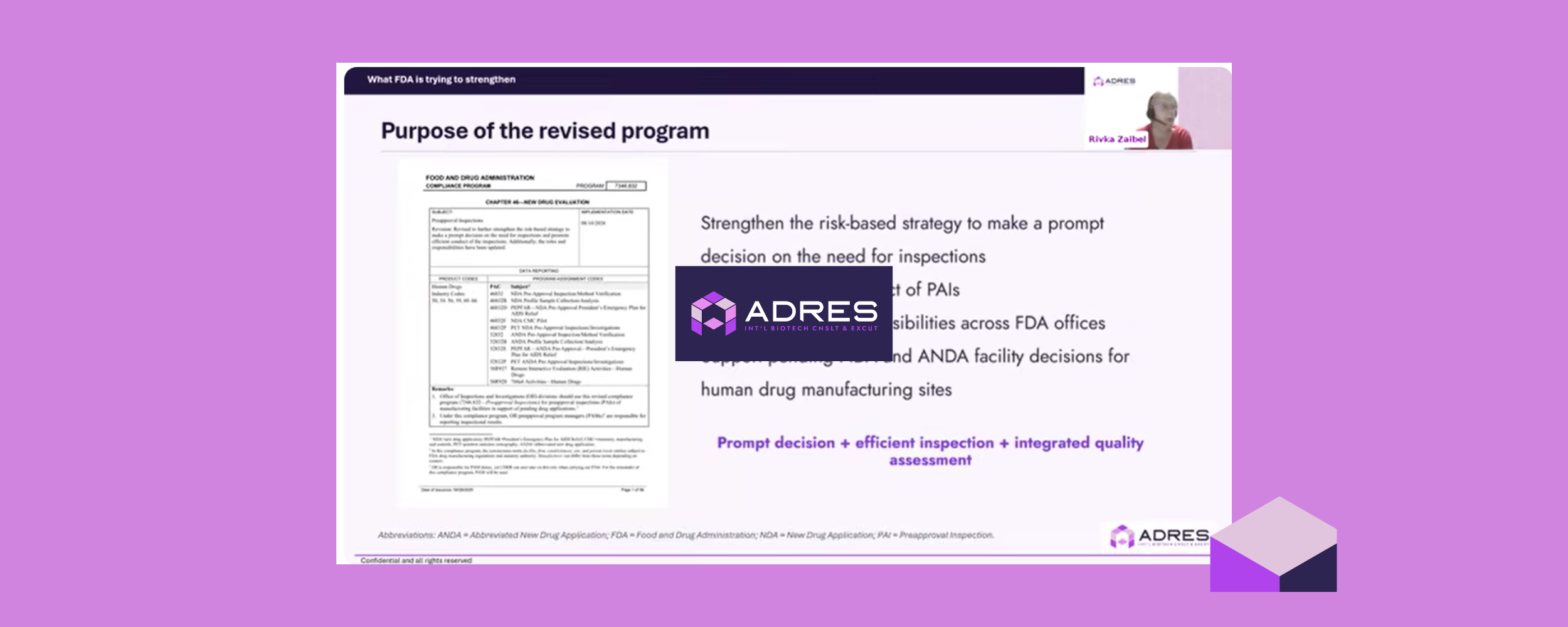
That is the practical focus of our ADRES webinar with Rivka Zaibel, Founder and President of ADRES, on FDA’s revised Compliance Program 7346.832, Preapproval Inspections, implemented on August 10, 2026. The revision strengthens FDA’s risk-based approach to deciding whether an inspection is needed, focusing inspection coverage, and coordinating the offices involved in application assessment. FDA Compliance Program 7346.832, pp. 1–2, pp. 9–14.
Watch the accompanying webinar for Rivka’s practical discussion of how development, quality assurance, quality control, manufacturing, validation, and regulatory teams can prepare.
Start with the right scope
Program 7346.832 supports facility assessment for pending New Drug Applications (NDAs) and Abbreviated New Drug Applications (ANDAs). FDA directs prelicense and preapproval inspections for biologics license applications to the separate program 7346.832M for CDER-regulated biological product manufacturers. The principles discussed here can inform broader readiness work, but the applicable inspection program matters.
A preapproval inspection (PAI) is closely tied to the product and application under review. FDA assesses whether the establishment can perform its proposed activities and whether the supporting data can be trusted. Significant issues can lead to a recommendation to withhold approval based on the facility assessment. A site’s previous inspection history therefore needs to be considered alongside its ability to manufacture or test this particular product. FDA program, p. 2, pp. 9–10, pp. 35–36.
FDA first decides whether an inspection is needed
The webinar distinguishes two related activities: preapproval facility evaluation and preapproval inspection.
During facility evaluation, FDA considers the proposed operations, product and process risks, inspection and compliance history, and the accuracy and reliability of application information. Its Integrated Quality Assessment (IQA) team uses that assessment to determine whether a PAI is needed.
FDA may also use reports from trusted foreign regulatory partners, records requests under section 704(a)(4) of the Federal Food, Drug, and Cosmetic Act, or remote interactive evaluations. These tools may support assessment in advance of, or in place of, an inspection when appropriate. The decision remains FDA’s; alternative tools do not provide a company with an automatic exemption from inspection. FDA program, pp. 9–12.
The preparation implication is straightforward: records and technical explanations need to be ready for assessment before a visit is scheduled. A remote request can expose the same gaps in traceability, process understanding, or application consistency that would become visible on site.
The four objectives remain, with coverage directed by risk
The program retains four primary objectives: readiness for commercial manufacturing, conformance to the application, data integrity, and commitment to quality in pharmaceutical development.
The revised coverage model is particularly useful when planning readiness activities:
| Inspection area | Coverage under the revised program |
| Objective 1a: manufacturing and laboratory capabilities, development changes, deviations, and trends | Every PAI |
| Objective 1b: sampling, testing, material evaluation, and supplier qualification | Selected according to identified risks |
| Objective 1c: facility and equipment controls against contamination | Selected according to identified risks |
| Objective 1d: release, change management, investigations, and reporting procedures | Selected according to identified risks |
| Objective 1e: scientific justification of the commercial process and batch record | Every PAI; depth depends on validation progress and application issues |
| Objective 2: conformance to the application | Every PAI |
| Objective 3: data integrity audit | Every PAI; depth depends on findings |
| Objective 4: commitment to quality in development | Initial PAI, periodically thereafter based on risk, and following major changes to the quality system, management team, or corporate structure |
The inspection lead determines coverage with written input from the IQA team before the inspection. Significant findings can lead to broader coverage, including the current good manufacturing practice (CGMP) surveillance program where appropriate. FDA program, pp. 12–14.
For companies, risk-based coverage should guide prioritization. Applicable cGMP obligations continue to apply even when an area is not selected for detailed review during a particular PAI.
Development history must explain commercial readiness
One of the webinar’s strongest practical themes is the connection between development knowledge and the proposed commercial process.
Teams should be able to explain what they learned from development batches, analytical method work, scale-up, deviations, and equipment performance. They should also show how that knowledge changed the process or its controls.
Rivka describes a recurring difficulty during inspections: a person can explain how to perform a process step but cannot explain its purpose or scientific rationale. Preparation should build that understanding within each person’s responsibilities.
An analytical method that needed modification after transfer, an unexplained trend, or repeated operator workarounds can raise questions about readiness. Closing the associated record does not, by itself, show that the underlying issue has been understood and controlled.
FDA recognizes that development investigations may be less comprehensive than those required for marketed drugs. Nevertheless, development data and information should be documented and objectively assessed. That distinction matters for growing companies: phase-appropriate systems must still preserve the evidence needed to justify later decisions. FDA program, pp. 19–20, pp. 23–25.
Process validation timing needs careful interpretation
Objective 1e links the proposed commercial process and batch record to the process validation lifecycle. At a minimum, Stage 1 process validation data should be available at application submission. The evidence should support process feasibility, the control strategy, and the chosen manufacturing parameters.
In the closing Q&A, Rivka makes Stage 1 concrete: development studies can examine raw-material variability, the effect of sourcing materials from different suppliers, and process boundaries such as a temperature range. These studies help teams understand where the process is vulnerable and justify the controls they choose and define the design space. In addition to the Stage 1, it is expected that during the PAI the Stage 3 CPV protocol is available for review.
The program states that an NDA or ANDA withhold recommendation will not be made solely because complete commercial-scale process validation is unavailable at the time of the PAI. This is a specific qualification, not a general permission to defer demonstration of readiness.
Failed full-scale process performance qualification (PPQ) studies showing an uncontrolled process without appropriate changes can support a withhold recommendation. If a company says PPQ is complete, FDA can audit the studies and conclusions. Before distribution, the manufacturer must achieve a high degree of assurance that the process consistently produces product meeting its quality attributes. Specific preapproval validation expectations also apply to aseptic filling and sterilization processes. FDA program, pp. 23–25, pp. 35–36. With regards to biological manufacturing Rivka emphasized the need to have a complete PPQ available for review.
A useful preparation exercise is to identify what has been demonstrated, what remains planned, the scientific basis for that plan, and the evidence needed before commercial distribution. Continued process verification should also be planned as part of the lifecycle.
Make the application traceable to the site
Conformance to the application requires a direct comparison between the submitted chemistry, manufacturing, and controls (CMC) description and the actual formulation, process, analytical methods, equipment, and manufacturing records.
The same discipline applies to the relationship between pivotal clinical batches or biobatches, stability batches, and the proposed commercial process. Differences need to be understood, justified, and appropriately reflected in the regulatory information. Development or scale-up changes are not automatically deficiencies; their implications must be assessed. FDA program, pp. 24–28.
Rivka recalls an inspection by another regulatory authority where the inspectors had an outdated description of the process and equipment. The discrepancy had to be addressed and the application updated. The lesson is to keep regulatory information and site operations aligned throughout the review period.
The Q&A also addresses whether a discretionary process change can wait until after approval. Rivka frames this as a risk assessment: consider whether the change is necessary to supply the product and how its timing could affect the approval decision. This requires a case-specific regulatory assessment, including the applicable reporting route for any postapproval change.
In the webinar, Rivka recommends building a CMC-to-record traceability map before submission. For each important application statement, identify the supporting report, executed record or raw data, the responsible site, and the person who can explain it.
She also highlights a familiar problem: an important development report may have been written years earlier by someone who has since left the organization. Finding the document is only part of preparation. Someone on the current team must understand the work well enough to explain its rationale and conclusions.
For an outsourced program, test this across the applicant, manufacturer, and analytical laboratory. A document held by a contractor must still be accessible when needed, with clear responsibility for resolving discrepancies.
Data integrity includes the context behind a result
FDA may compare CMC summaries with original chromatograms, laboratory notebooks, electronic files, and other supporting records. Its audit can include development data, stability, dissolution, content uniformity, and API impurity information.
The question extends beyond whether a reported number matches a source record. The surrounding data must also support the conclusion: unexplained gaps in an analytical sequence, unjustified repeat testing, improper invalidation of out-of-specification results, or substitution of passing results can undermine confidence in the submission. FDA program, pp. 27–30.
For readiness, select important CMC data sets and reconstruct their full history. Check that the original records are retrievable, exclusions are scientifically justified, and investigations explain how unexpected results were evaluated. Prepare the people responsible for those records to explain both the result and the decision-making behind it.
Quality in development requires visible management involvement
Objective 4 examines how the development program is resourced, managed, and assessed, including quality assurance (QA) oversight, cross-functional participation, knowledge management, and quality risk management.
There is an important regulatory boundary: information from this objective generally supports FDA’s analysis and trending. A shortfall in an Objective 4 element should not be cited on Form FDA 483 unless it can be linked to a cGMP violation. Significant cGMP deficiencies identified through this coverage are cited under Objectives 1, 2, or 3, as applicable. FDA program, pp. 30–31.
The practical value is to make management involvement observable. Teams should know who owns residual risks, how technical decisions are reviewed, and how resources are committed when a readiness gap needs to be resolved.
What teams should revisit now
Use the revised program to test readiness across functions:
- Confirm the product and site scope. Identify the application, each establishment’s role, and the applicable inspection program.
- Reconcile CMC commitments with site evidence. Check current methods, batch records, specifications, and supporting data across internal and external sites.
- Review unresolved development and scale-up issues. Assess deviations, trends, changes, and whether corrective actions demonstrably address the problem.
- Check the validation rationale. Connect Stage 1 knowledge to commercial controls, PPQ plans or results, and continued process verification.
- Test raw-data retrieval. Confirm that selected submission claims can be reconstructed from complete, reliable records.
- Prepare technical experts and leadership. Ensure they can explain the science, the remaining risks, and the decisions within their responsibilities.
Preparation should begin alongside submission planning. FDA retains the right to inspect during the review cycle, whether or not it has already communicated an intention to visit. FDA program, p. 15.
Watch the accompanying ADRES webinar for the full discussion. For support with inspection readiness, CMC traceability, data integrity, or process validation readiness, contact ADRES.

