
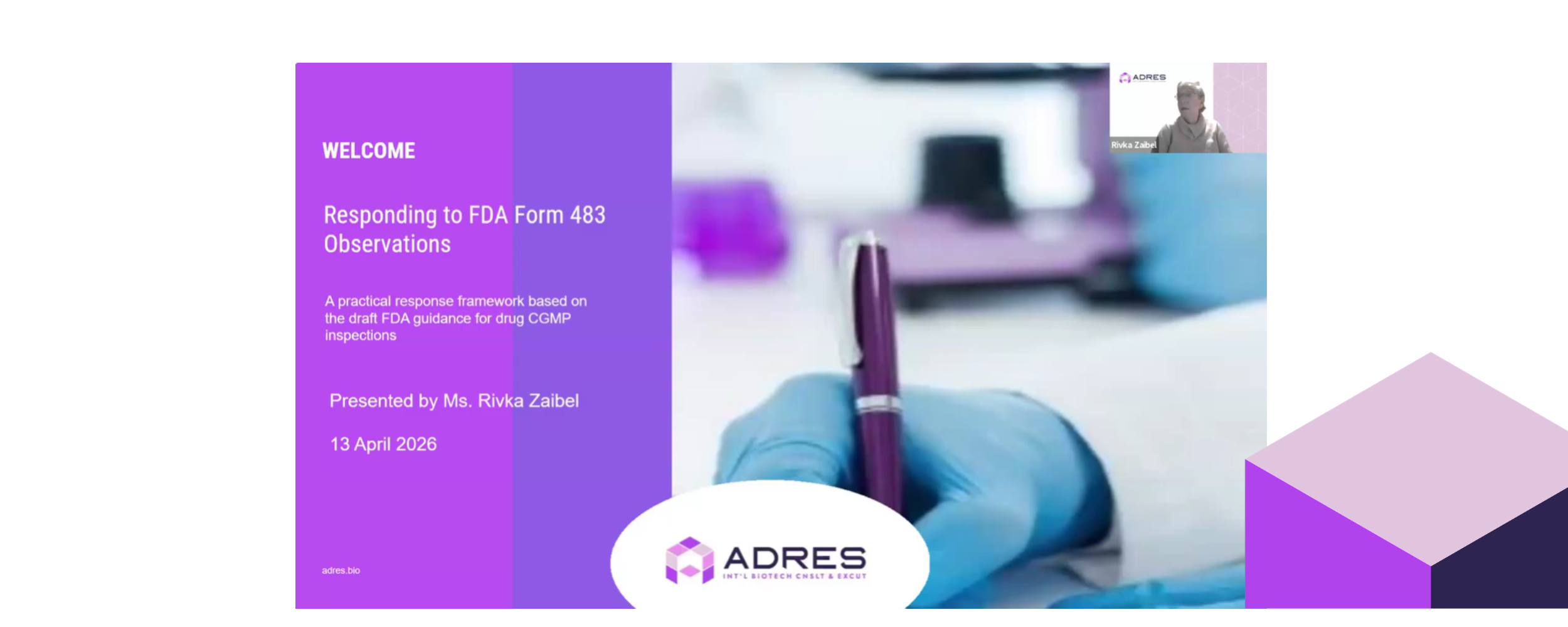
FDA Form 483 Responses: The Difference Between Explaining an Observation and Demonstrating Control
The companies that struggle most after a Form FDA 483 is issued are often not the ones that lack words. They are the ones who lack control.
That is what the FDA’s March 2026 draft guidance makes clearer than before.
🎥 Prefer a practical walkthrough? Watch the full webinar
The document does not create a new legal standard, and it is still a draft and nonbinding. But it does put in writing, in a much more structured way, what the FDA expects to see when a company submits a response to the FDA 483 form after a drug cGMP inspection.
That was also the central point in our recent webinar. A company’s response to the FDA 483 form is not a writing exercise. It is not a negotiation over wording. It is not a test of how quickly a company can send a polished letter back to the Agency.
It is a test of whether the company actually understands the problem. Not only the words on the form, but the operational, quality, and patient risk behind them.
A weak response answers the observation.
One of the clearest traps companies fall into is treating the FDA 483 like a list of comments to address one by one.
That approach feels efficient. It is usually not enough.
A strong response does more than answer the cited point. It shows that the company has stepped back and asked the harder question: if the FDA found this here, where else might the same weakness exist? That is the real discipline FDA is looking for. Similar products. Similar processes. Related systems. Other equipment. Potential impact on the distributed product. Whether the issue is isolated or whether it points to something broader.
The draft guidance reflects exactly that mindset. FDA recommends a patient- and product-focused risk assessment, including an assessment of inventory and distributed drugs still within expiry, and expects companies to address the scope and whether the issue may be isolated or systemic.
Find out how ADRES can help you align your FDA 483 response with FDA expectations.
Contact Us
So here is the practical distinction. A narrow response reacts to the example the FDA wrote down. A strong response demonstrates that the company understands the system behind the example.
The investigation is where the response usually succeeds or fails
In practice, many company responses to the FDA 483 form are weakened long before drafting starts. They are weakened in the investigation.
That point came through clearly in the webinar. The same familiar issues often sit behind observations: shallow deviation handling, weak root cause work, incomplete follow-through, validation gaps, data integrity concerns, and a failure to ask whether one event is part of a wider pattern.
The common mistake is to stop at the first explanation that sounds plausible. The correct approach is to keep going until the company can show why the issue happened, how far it reaches, and why the proposed corrective action matches the actual cause rather than the most visible symptom.
FDA’s draft guidance is direct on this. It recommends a detailed investigation report covering scope, associated drugs and lots, identified root causes, related systemic issues, CAPA, completed and interim actions, and effectiveness evaluation. It also recommends a scientifically justified, risk-based investigation scope, including justification for exclusions.
That matters because weak investigations do not stay small. A narrow event can quickly become evidence that the quality system is not seeing itself clearly.
The FDA also expects companies to know when outside expertise is needed
Another point that should not be overlooked is the FDA’s express recognition that external expert support may be appropriate.
The draft guidance states that a consultant may be useful for additional insight to understand and assess inspectional observations and to develop an appropriate CAPA plan. FDA goes further in cases involving data integrity findings, where it recommends engaging a cGMP consultant.
This is an important practical point. In complex cases, an experienced external consultant can help the company test whether its response logic is strong enough, whether the investigation scope is too narrow, whether the root cause analysis is adequately supported, and whether the overall company response to the FDA 483 form is written in the manner, structure, and scope FDA expects.
This is not about outsourcing responsibility. The company remains fully responsible for the content, commitments, and execution. But using an expert consultant can help validate that the response is not only technically sound but also organized in a way that makes the FDA’s review easier and more credible.
That can be especially valuable when the company is under time pressure, dealing with repeat observations, responding to broad system deficiencies, or preparing a response that may affect a pre-approval timeline.
Executive management is not a sign-off layer. It owns the response.
Another important point, both in the guidance and in the webinar, is that a company’s response to the FDA 483 form is not just a QA document.
It is a management commitment.
FDA says the response should identify who prepared it and should be signed by executive management with the authority to allocate resources and implement commitments. The guidance also places responsibility on management to assess risk, support the investigation, and ensure adequate resources for remediation.
That is not a formality. It has operational meaning.
When executive management signs a company’s response to the FDA 483 form, the company is not only saying it understands the observation. It says it is prepared to commit people, time, budget, and organizational attention to fixing the issue properly. That means the response cannot remain trapped inside QA. It requires cross-functional ownership across quality, manufacturing, technical operations, regulatory, and leadership.
Strong companies understand this early. Weaker companies discover it late.
The executive summary matters because it exposes whether the remediation plan is real
FDA’s draft guidance includes an executive summary table. It would be easy to dismiss that as a presentation.
It is not.
A structured summary forces discipline. It requires the company to show, in one place, what the observation is, which system it belongs to, what CAPA it ties to, what has already been completed, what interim controls are in place, what target dates exist, and what remains open.
FDA’s example includes fields such as the observation number, general category or system, summary, CAPA number, target date including interim actions, and current remediation status.
That is useful not only for FDA review. It is useful internally because it reveals very quickly whether the company has a real remediation program or only a loose collection of intended actions.
The 15-business-day window is more serious than many teams still assume
The draft guidance sharpens the practical meaning of timing.
The FDA recommends one complete company response to the FDA 483 form addressing all observations within 15 business days. For complex issues that cannot be fully resolved in that period, the FDA recommends that companies still submit a CAPA plan, interim measures, and a proposed timeframe for substantive follow-up within that same window. The guidance also states that the FDA will not ordinarily delay regulatory action, such as a warning letter, to review a response received after that period.
That changes the way companies should think about the first response.
The first response does not need to claim that everything is finished. It does need to show seriousness. It should show that the company has assessed risk, started the right investigation, defined interim protections, assigned ownership, and built a credible path to completion.
This is especially important in pre-approval settings, where the effect of a weak or delayed response can have a direct impact on product approval.
Repeat observations are not about memory. They are about system credibility.
One of the most practical lessons from the webinar was the focus on repeat observations.
FDA does not look only at each observation in isolation. It looks for patterns. If similar issues recur across inspections, or if related gaps appear across multiple systems during the same inspection, the message becomes much more serious.
The draft guidance tells companies to review past inspections and internal audits for repeat observations or similar trends, and notes that this trend review may highlight a systemic issue at a facility or across an organization.
That is why companies should read a 483 in two directions. First, observation by observation. Second, as a whole. The second reading often tells you more about regulatory risk than the first.
CAPA should start during the inspection, not after it
Another practical point from the webinar was timing inside the inspection itself.
Companies should not wait until the company’s response to the FDA 483 form is being drafted to start building their CAPA logic. They should begin assessing risk, clarifying issues, and identifying real corrective actions while the inspection is still underway.
FDA’s draft guidance aligns with that approach. It says establishments are encouraged to begin developing a CAPA plan during, or immediately after, the inspection.
That does not mean cosmetic fixes. It does not mean rewriting a procedure and hoping that counts as remediation. It means starting the real work early enough that the eventual response reflects actual operational thinking rather than post-inspection improvisation.
Disagreements should be raised early, calmly, and with evidence
Not every observation has to be accepted without question.
Scientific and technical disagreements do arise. But the difference between a credible disagreement and a weak one is method.
FDA says companies should seek clarification with FDA representatives during the inspection when scientific or technical disagreements arise, and unresolved disagreements can then be addressed in the company’s response to the FDA 483 form.
That is also the practical discipline companies should adopt. If the company believes the investigator misunderstood a process or reached the wrong technical conclusion, the response should be grounded in data, applicable regulations, guidance, standards, and clear scientific reasoning.
Not defensiveness. Not tone. Evidence.
What companies should revisit now?
The practical takeaway is not complicated.
Companies should revisit how they scope a company response to the FDA 483 form. They should test whether their investigations truly reach the root cause. They should make sure CAPA plans are tied to risk, ownership, interim controls, timelines, and effectiveness checks. They should also consider when an experienced external consultant can strengthen the assessment, validate the response approach, and help ensure the package is structured in the way the FDA expects. And they should ensure leadership understands that the response is an organizational commitment, not a document that QA prepares in isolation.
That is why the March 2026 draft guidance matters. Not because it changes everything. Because it makes the standard for a credible response much harder to pretend not to understand.
Watch the full webinar
For the full discussion, including practical examples on scope, repeat observations, management responsibility, CAPA timing, use of expert consultants, and how to handle technical disagreements, watch the webinar recording here

