
PDA TR 60 Revised 2026: What Process Validation Teams Should Revisit Now
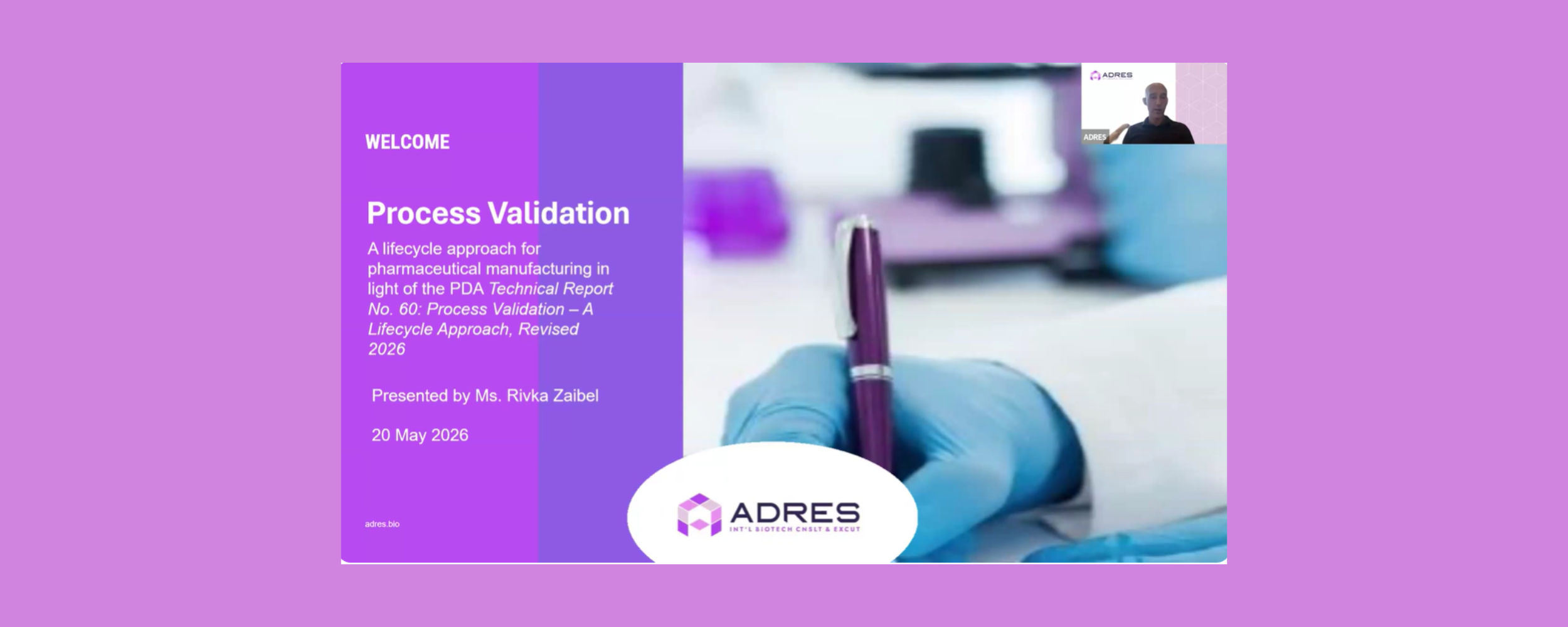
This article is based on the ADRES webinar I recently presented on the revised PDA Technical Report No. 60: Process Validation, A Lifecycle Approach.
🎥 Prefer a practical walkthrough? Watch the full webinar
The central message is clear: process validation is not a one-time confirmation exercise. It is a lifecycle activity that starts with process design, continues through process qualification, and remains active during routine manufacturing.
The revised report reflects current regulatory expectations and reinforces a practical point that quality, validation, CMC, manufacturing, and regulatory teams should not overlook: process validation depends on accumulated knowledge, risk-based justification, and continued monitoring. It is not enough to complete a protocol, manufacture a defined number of batches, and treat validation as finished.
Why the revision matters
The updated PDA TR 60 places strong emphasis on lifecycle thinking. Process validation begins with the knowledge generated during development and continues as that knowledge is tested, confirmed, monitored, and updated.
For companies moving toward PPQ, preparing for commercial manufacture, supporting post-approval changes, or managing ongoing production, this creates a practical expectation: each stage must produce useful knowledge for the next stage.
Stage 1 should define the process and the control strategy. Stage 2 should confirm that the commercial process performs as expected under qualified conditions. Stage 3 should verify that the process remains in control during routine production.
The connection between the stages is where I often see teams needing to focus.
Need support applying PDA TR 60 to your validation strategy? Contact ADRES to discuss PPQ readiness, CPV, and inspection-ready process validation.
Contact Us
Stage 1: Process design must create usable evidence
Stage 1 is not just early development work. It is the foundation for PPQ readiness and future process control.
At this stage, teams should be able to define and justify the relationship between the product, process, materials, analytical methods, and control strategy. This includes identifying critical quality attributes, critical process parameters, critical material attributes, operating ranges, sampling points, in-process controls, hold times, yields, and analytical methods.
One example I often use is pH during fermentation. If a company defines pH as critical, and then a batch is manufactured outside the defined range, the team cannot later argue that the excursion does not matter without strong scientific justification. The criticality decision has consequences.
This is a point I try to emphasize with development and manufacturing teams: definitions are not theoretical. Once a parameter or attribute is classified as critical, the company must be able to explain how it is controlled, what happens when it deviates, and whether affected material can still support validation.
Stage 1 should therefore result in more than process familiarity. It should produce documented process understanding.
PPQ readiness is an evidence review, not a checklist
One of the most practical takeaways from the revised TR 60 is that readiness for PPQ should be treated as an evidence review.
Before PPQ begins, teams should confirm that the commercial process is sufficiently understood and that supporting systems are ready. This includes qualified facilities, utilities, equipment, instruments, trained personnel, validated or suitably qualified analytical methods, approved protocols, and a defined approach to data analysis.
The revised TR 60 reinforces that the number of PPQ batches should not be selected automatically. Prior knowledge, process complexity, risk level, platform experience, available Stage 1 data, and statistical confidence should all be considered.
In my experience, this is one of the areas where companies need to be especially careful. For some products, three batches may be appropriate. For others, the justification may point to more data, additional engineering batches, enhanced sampling, or a different approach for specific unit operations.
The practical question is not simply, “How many batches are required?”
The better question is: “Do we have enough evidence to demonstrate that the process can consistently deliver product meeting its intended quality attributes?”
Stage 2: Protocols must define how data will be judged
A PPQ protocol should not only describe what will be manufactured. It should define what will be measured, how data will be analyzed, what acceptance criteria apply, and what decisions will be made based on the results.
That includes the sampling strategy, the process parameters and quality attributes to be monitored, the statistical tools to be used, and the response to deviations or unexpected results.
PPQ protocols should be approved before execution starts. This matters because post-hoc interpretation weakens the validation rationale. Teams should decide in advance how evidence will be evaluated.
This is especially important for organizations relying on prior knowledge, platform processes, small-scale models, or historical process data. These can support PPQ, but they must be scientifically justified, traceable, and linked to the commercial process.
Stage 3: Continued process verification needs predefined signal management
Continued process verification is the mechanism by which a validated process remains in control after PPQ.
A clear distinction should be made between an initial heightened monitoring period and ongoing routine monitoring. In practice, Stage 3A can be used to collect additional data after PPQ and verify that the process behaves as expected. Stage 3B then becomes the routine monitoring phase, where the company continues to evaluate process performance and respond to meaningful signals.
This requires planning.
Teams should define what will be monitored, how frequently data will be reviewed, what counts as a signal, who evaluates the signal, and what actions may be required. Without predefined rules, I have seen teams fall into two opposite problems: overreacting to isolated data points or failing to detect meaningful process drift.
CPV should also connect to annual product quality review, deviations, CAPA, change control, and process improvement. CPV should not be a disconnected statistical exercise. It should feed the quality system and support decisions about whether the process remains appropriate, whether controls should change, and whether additional validation work is needed.
What teams should revisit now
The revised PDA TR 60 is a good opportunity for teams to review whether their current process validation approach is sufficiently lifecycle-based.
Areas to revisit include:
- CQA, CPP, and CMA definitions
Confirm that criticality decisions are scientifically justified and consistently applied. - Stage 1 documentation
Review whether the process design report, QTPP, control strategy, risk assessments, design space, and acceptable ranges are current and traceable. - PPQ readiness criteria
Make sure readiness is based on evidence, not only on project timing. - PPQ protocol content
Confirm that sampling plans, acceptance criteria, statistical methods, deviation handling, and data analysis rules are defined before execution. - Use of prior knowledge
Check whether platform knowledge, historical data, small-scale studies, or engineering batches are properly justified for the specific product and process. - CPV monitoring strategy
Define the parameters and attributes to monitor, the review frequency, the signal rules, and the escalation process. - Knowledge management
Ensure that information generated in Stage 1, Stage 2, and Stage 3 is captured, reviewed, and used to improve future decisions.
The practical message
The revised PDA TR 60 does not turn process validation into a paperwork exercise. It does the opposite. It asks teams to connect process knowledge, risk management, statistical thinking, and quality system oversight across the full product lifecycle.
For companies preparing for PPQ, transferring a process, approaching commercial launch, or maintaining an approved process, the report provides a useful framework for asking whether the validation strategy is still fit for purpose.
In my view, the strongest validation programs are not built around a fixed number of batches. They are built around clear process understanding, justified controls, disciplined execution, and ongoing verification.
Watch the full ADRES webinar recording for the complete discussion of PDA TR 60 Revised 2026, including practical examples from Stage 1 process design, PPQ readiness, and continued process verification.
For questions about implementing PDA TR 60, PPQ readiness, continued process verification, validation strategy, or inspection readiness, contact ADRES.

